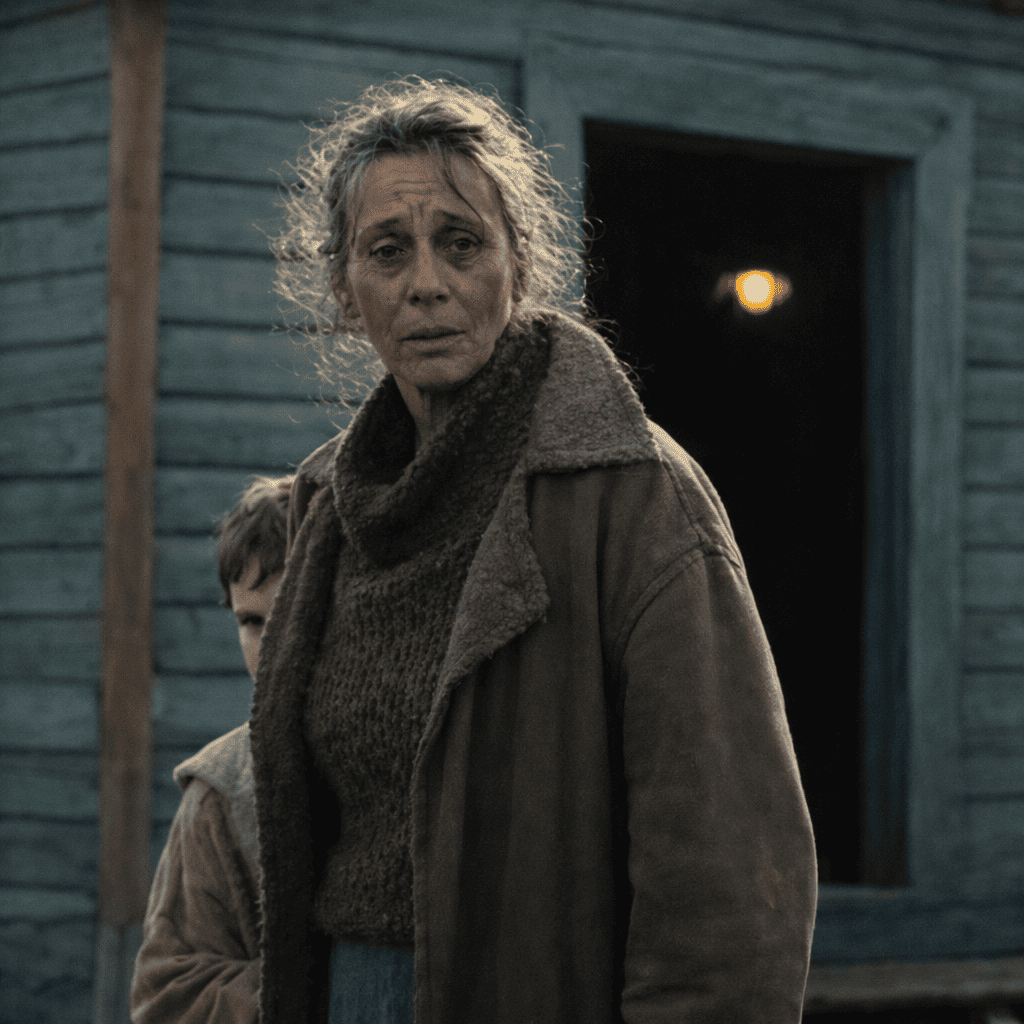
Martha was only 45, but her hands looked 70. She scraped the bottom of her flour jar. Only a dusting of white powder clung to her dry fingers. She knew what that meant: tonight, she wouldn’t eat.
Outside, the wind battered the wooden planks of her small farmhouse. The sky was pitch black, and the biting cold was beginning to seep through the cracks in the windows. She pulled her worn, moth-eaten cardigan tighter across her chest.
Suddenly, she heard a strange noise coming from the yard. It wasn’t the wind; it was something smaller. She should have locked her door, but her heart told her otherwise.
Trembling, she grabbed her oil lamp and opened the door. A little boy was slumped against the barn wall. He was wearing a shirt far too thin for winter, and he had no shoes. His bare feet were raw, red, and caked in dried mud. All alone in the world since sickness had taken his family, he had walked straight through the woods until his strength finally gave out.
The child wasn’t moving. His eyes were closed, and his face was deathly pale. Martha stepped closer and placed her hand on his forehead. He was as cold as stone.
With her tired arms, she scooped him up, carried him inside, and laid him down near the dying embers in the fireplace. She had almost no wood left, but she threw her very last log into the flames.
The little boy opened his eyes. He looked terrified. He tried to scramble backward, but he was too weak to move his legs.
“Don’t be afraid,” Martha said softly. “You’re safe here. What’s your name?”
It took the child a moment to answer. His voice was a raspy whisper. “Leo,” he said, before a shiver racked his small body.
Martha walked over to her cupboard. She pulled out the last piece of bread she had been saving for the next day. She broke it in two and gave the larger half to Leo. Leo stared at the bread with wide eyes. He devoured it in seconds, barely stopping to chew. Martha offered a small smile, even as she felt her own stomach crying out in hunger.
The Cruelty of Wealth
The next morning, the sun was shining, but the air remained bitterly cold. Martha was in the yard with Leo, trying to mend a fence with old scraps of rope, when a large black car pulled up the dirt driveway.
It was Peter, the wealthy neighbor who owned almost all the land in the valley. He stepped out, smoothing down his expensive fur coat.
Peter looked at Martha’s house with disgust. Then he looked at Leo, who was trying to hide behind Martha’s legs. Peter burst out laughing.
“What is this, Martha?” he asked, pointing a finger at Leo. “You already can’t pay your debts, and now you’re taking in stray dogs?”
Martha didn’t look away. She placed a reassuring hand on the child’s shoulder, feeling how tense the little boy was.
“He’s not a dog, Peter,” she replied flatly. “He’s a child who was hungry and freezing. I couldn’t leave him out there.”
Peter shook his head and pulled a ledger from his pocket, smirking as he looked at the numbers.
“You’re crazy,” Peter said. “Throw him out. Keep your bread for yourself. Because of him, you’ll starve before the month is over.”
Martha stood up straight. Her clothes were dirty and threadbare, but her gaze was fierce. She was no longer trembling in front of this rich man.
“You’re never too poor to have a heart,” she said firmly. “You might have all the money in the world, but you have absolutely nothing in your chest.”
Peter shoved his ledger back into his pocket and climbed back into his car, slamming the door. He sped off in a cloud of dust, shouting that she would end up on the street. Martha looked down at Leo and gave him a sad smile.
The Promise
Years went by. Martha’s life became a daily struggle. The weather changed, and the land stopped yielding crops. She sold her last chickens, and then her only cow.
Leo grew up by her side. He helped her as much as he could, but there was no work to be found in the village. Eventually, the day came when he had to leave for the big city to try and earn a living.
On the day of his departure, Martha gave him her life savings, hidden under her mattress. It was only a few coins, but it was all she had left. Leo cried as he kissed her forehead.
“I’ll come back, Martha,” he promised. “I promise I’ll come back, and you’ll never go hungry again.”
Martha was left alone. The months turned into years. Silver threads began to weave through her hair, and her hands grew tired much faster under the weight of her tools. But every morning, she looked out at the road, her eyes still bright with hope. She waited for news, but the mail never came.
The Third Day
One day, a man in a gray suit knocked on her door. He was a clerk from the city bank. His face was stony, and he didn’t even look Martha in the eye.
“You have three days to vacate,” he said, handing her an official document. “The farm is being auctioned off to pay your debts.”
Martha sat down on her old wooden bench and looked at her calloused hands. She had worked this land her entire life, and now she was going to die on the side of the road.
The third day arrived. Martha had packed her few belongings into a small cloth sack. She was getting ready to close the door to her home for the very last time.
Suddenly, the roar of a powerful engine shattered the quiet morning. A stunning luxury car—more beautiful than anything the village had ever seen—pulled up to the gate. Its paint gleamed like a mirror in the sun. Villagers stepped out of their homes to stare. Peter, the wealthy neighbor, was there too, his mouth hanging open in shock.
A tall, elegant man stepped out of the car. He wore a perfectly tailored black suit. He walked with absolute confidence toward the decrepit old house.
Martha squinted. She didn’t recognize this rich stranger. But when he stopped in front of her, he smiled. And that smile, she knew by heart.
“Leo?” she whispered, her voice breaking. Her legs gave out, and she nearly collapsed, but the man caught her just in time.
“It’s me, Martha,” he said, pulling her into a tight embrace. “I’m so sorry it took so long. I had to work hard to make it.”
Leo turned to the bank clerk, who was waiting with the keys. He pulled out a checkbook and wrote a sum that made the man in the suit turn pale.
“This is for the debt,” Leo said. “And here is a little extra, to ensure that Martha’s name is the only one on the deed. Forever.”
Peter stepped forward, looking both jealous and confused. He opened his mouth to speak, but Leo shot him an ice-cold glare. Peter lowered his head and walked away without a word.
Leo gently took Martha’s hands in his. They were just as rough as ever, but now, they would never tremble with fear again.
“Why did you do all this for me?” Martha asked, crying tears of joy. She couldn’t believe this towering, successful man was the starving little boy she had saved.
Leo looked past her, toward the old barn where he had hidden that winter night. He remembered the taste of the dry bread and the warmth of Martha’s last log in the fire.
“You gave me a home when I had nothing,” he said, his voice thick with emotion. “You shared your last meal with a stranger when you had nothing yourself.”
Leo opened the door of his luxury car and helped Martha settle into the soft leather seats. He tossed her worn cloth sack into the back.
“Today, it’s my turn to take care of you,” he added. “You will never go without again, I swear it.”
They drove away from the farm as the sun rose over the valley. Martha watched the scenery roll by, knowing that her life of suffering was finally over. She thought back to what Peter had told her all those years ago.
She knew now that she had been right all along: a good heart is the only wealth that truly matters.